
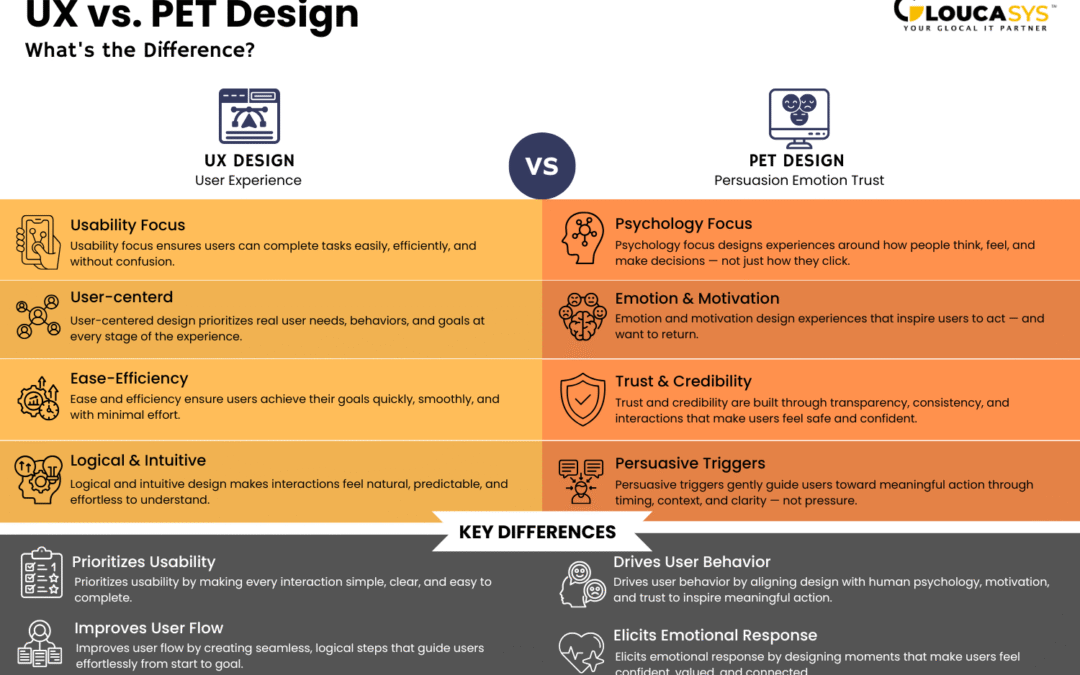
Most products today are usable.
Yet many still fail to get adoption.
Why?
Because UX isn’t only about whether users can do something — it’s about whether they will.
That’s where PET Design comes in.
The PET Framework in UX Design
PET expands UX beyond screens and flows into human decision-making.
🧩 PET stands for:
- Performance – Can users complete the task easily?
- Emotion – How do users feel while interacting?
- Trust – Do users believe in the system enough to rely on it?
Great UX sits at the intersection of all three.
PET Design: From “Can Do” to “Will Do”
Here’s a simple way to visualize PET 👇
WILL DO
▲
Persuasion Design
│
┌─────────────────┐
│ Validation │
│ Design │
│ Assessment │
└─────────────────┘
│
Strategy
│
Science
▼
CAN DO
How it works:
- Performance Design ensures users can use the product
- Emotion Design creates motivation and confidence
- Trust Design removes doubt and friction
- Persuasion Design guides users toward meaningful action
UX success happens when ability + emotion + trust align.
Why PET Matters More Than Ever
In a world of:
- Feature-heavy products
- AI-driven interfaces
- Low user patience
Usability is the baseline. PET is the differentiator.
Users don’t just interact with products —
they judge, feel, and decide within seconds.
Final Thought
Performance lets users act.
Emotion makes them care.
Trust makes them stay.
That’s not just UX.
That’s PET-driven design.

