
For decades, enterprise search has worked on a simple principle:
Type a keyword. Find a document. Open it. Search again.
That model made sense when enterprise knowledge lived primarily in documents, intranets, shared drives, and databases.
But modern enterprises have changed.
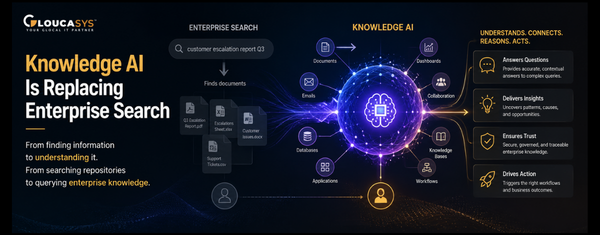
Knowledge is now distributed across documents, emails, applications, dashboards, collaboration platforms, databases, workflows, and increasingly, AI-generated content.
The problem is no longer simply finding information.
The problem is understanding it, connecting it, and turning it into action.
This is where Knowledge AI is changing enterprise search.
From Finding Information to Understanding Knowledge
Traditional enterprise search answers:
“Where is the information?”
Knowledge AI aims to answer:
“What does the information mean, and what should I do with it?”
Instead of returning hundreds of documents for a query, Knowledge AI can understand the intent behind a question, retrieve relevant information across enterprise systems, synthesize the findings, and provide a contextual answer.
For example:
Traditional Search:
“Show me the Q3 customer escalation reports.”
Knowledge AI:
“Which customers experienced recurring issues in Q3, what caused them, and which corrective actions are still open?”
The second question requires more than keyword matching.
It requires enterprise context, reasoning, relationships, and trusted data.
Enterprise Knowledge Is Not Stored in One Place
A typical enterprise may have critical knowledge distributed across:
- ERP and CRM systems
- Document management platforms
- Emails and collaboration tools
- Knowledge bases and intranets
- Data warehouses and data lakes
- Operational applications
- Engineering systems
- Customer support platforms
- Business dashboards
- Policies and process documentation
Traditional search treats these sources largely as separate repositories.
Knowledge AI can create a more connected knowledge layer across them.
This creates an important shift:
From searching repositories → to querying enterprise knowledge.
The Real Value Is Context
Finding a document is only the beginning.
Employees often spend significant time determining:
- Which document is current?
- Which information is relevant?
- Does this policy apply to this situation?
- What changed since the previous version?
- Which system contains the latest data?
- Who owns the issue?
- What action should happen next?
Knowledge AI can bring these pieces together.
Imagine asking:
“Why did production efficiency decline at Plant A this month?”
Instead of returning reports, Knowledge AI could connect production metrics, maintenance records, equipment events, energy consumption, operational logs, and historical trends to create a contextual explanation.
That is fundamentally different from search.
Knowledge AI Creates an Enterprise Intelligence Layer
The long-term opportunity is bigger than replacing a search box.
Knowledge AI can become an intelligence layer between employees and enterprise information.
Employees ask questions naturally.
AI retrieves relevant information.
AI understands relationships.
AI summarizes the evidence.
AI identifies insights.
And, where appropriate, AI can trigger the next workflow.
This creates a progression:
Search → Retrieval → Understanding → Reasoning → Action
That is the real transformation happening inside enterprise knowledge management.
But Enterprise Knowledge AI Needs Trust
Enterprise knowledge cannot operate like a generic chatbot.
Organizations need confidence that AI responses are:
Accurate. Relevant. Secure. Traceable.
That requires strong foundations:
- Permission-aware retrieval
- Enterprise-grade data governance
- Source attribution
- Data lineage
- Role-based access
- Model governance
- Security controls
- Human oversight
- Continuous knowledge updates
The AI should not simply provide an answer.
It should provide an answer that the organization can trust and verify.
The Next Enterprise Interface May Be a Question
Employees have traditionally learned how to navigate enterprise software.
They remember where reports are stored.
They learn which dashboard contains which KPI.
They know which application contains which process.
Knowledge AI introduces a different interaction model.
Instead of asking:
“Which system should I open?”
Employees can ask:
“What do I need to know?”
That could fundamentally change how people interact with enterprise technology.
The future enterprise may not be defined by how many systems employees can navigate.
It may be defined by how intelligently those systems can understand and serve enterprise knowledge.
The Competitive Advantage
The organizations that benefit most from Knowledge AI will not necessarily be those with the largest AI models.
They will be the organizations that can connect:
Data + Knowledge + Context + AI + Governance + Action
Because enterprise intelligence does not come from AI alone.
It comes from giving AI access to the right knowledge, within the right context, under the right controls.
The Enterprise Search Era Is Evolving
Enterprise search helped employees find information.
Knowledge AI can help them understand information.
And the next generation of enterprise AI will help them act on that knowledge.
The question for organizations is no longer:
“How can we build a better search engine?”
It is:
“How can we turn our distributed enterprise knowledge into intelligence?”
That is where the next generation of enterprise productivity will be created.

