
Artificial intelligence is moving from experimentation to enterprise-critical operations. Organizations are no longer asking whether they should adopt AI—they are asking how to deploy it securely, reliably, and at scale without losing control of their data, models, or infrastructure.
This is where Private AI becomes increasingly important.
Private AI is often described as an AI environment where sensitive enterprise data remains protected. But privacy cannot be achieved through software controls alone. If the underlying infrastructure is shared, externally controlled, or poorly governed, enterprises may still face risks around data exposure, compliance, performance, and operational dependency.
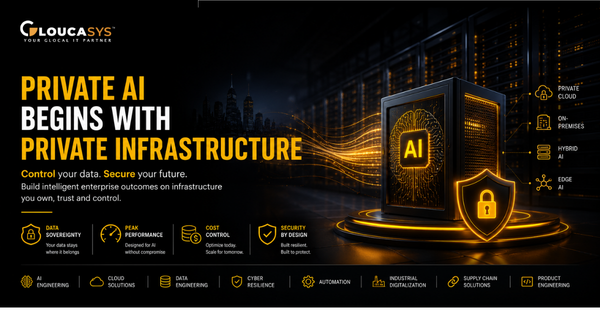
Private AI begins with private infrastructure.
What Does Private AI Really Mean?
Private AI is an enterprise AI architecture designed to keep critical data, models, workloads, and processing environments under organizational control.
It can involve:
- AI models deployed within enterprise-controlled environments
- Sensitive data processed without unnecessary external exposure
- Private cloud, on-premises, or hybrid infrastructure
- Dedicated compute and storage resources
- Controlled access to AI workloads and data
- Strong identity, security, and governance mechanisms
- Infrastructure designed around enterprise compliance requirements
The goal is not simply to hide data from external platforms.
The goal is to create an AI environment where the enterprise controls the complete data-to-intelligence pathway.
Why Infrastructure Matters More Than Ever
AI workloads are fundamentally different from traditional enterprise applications.
Large-scale training and inference require significant GPU compute, high-performance storage, low-latency networking, efficient data pipelines, and sophisticated orchestration.
If these layers are not designed together, AI performance can quickly become constrained.
A powerful GPU cluster cannot deliver enterprise-scale AI if:
- Data cannot reach the GPUs fast enough
- Storage becomes a bottleneck
- Network latency limits workload performance
- Infrastructure costs become unpredictable
- Security controls slow down production workflows
- AI workloads compete with unrelated workloads
- Capacity cannot scale when demand increases
This creates an important shift in thinking:
AI infrastructure is no longer simply a foundation for applications. It is part of the AI capability itself.
The Private Infrastructure Advantage
A properly designed private AI infrastructure gives enterprises greater control across four critical dimensions.
- Data Control
Enterprise AI often operates on highly sensitive information—customer records, financial data, intellectual property, engineering information, operational data, and proprietary business processes.
Keeping AI workloads within controlled infrastructure can reduce unnecessary data movement and provide stronger governance over where information is stored and processed.
This is particularly important for industries operating under strict regulatory, privacy, or data-residency requirements.
- Security
Private infrastructure allows security architecture to be designed around the AI workload rather than added after deployment.
Enterprises can establish controlled network boundaries, identity policies, encryption, workload isolation, privileged access controls, monitoring, and security operations specifically for AI environments.
The result is a more defensible architecture for mission-critical AI.
- Performance
AI performance depends on more than GPU specifications.
The complete infrastructure stack matters:
Data → Storage → Network → Compute → Model → Application
If one layer cannot keep pace with the others, the entire pipeline suffers.
High-performance storage, NVMe-based architectures, optimized networking, GPU orchestration, efficient data pipelines, and workload-aware infrastructure design can significantly improve utilization and reduce wasted compute capacity.
- Cost and Operational Control
Cloud AI can accelerate experimentation, but production-scale AI can introduce substantial and unpredictable infrastructure costs.
Private infrastructure provides enterprises with greater visibility into their compute utilization, workload patterns, capacity planning, and long-term infrastructure economics.
The objective is not necessarily to eliminate cloud.
It is to create the right infrastructure strategy for the right AI workload.
Private AI Is Not the Same as On-Premises AI
Private AI does not mean every AI workload must run inside a traditional data center.
Enterprises can build private AI environments across multiple architectures:
On-Premises
Maximum control for highly sensitive workloads and environments with strict data requirements.
Private Cloud
Greater flexibility while maintaining dedicated infrastructure and stronger governance.
Hybrid AI
Sensitive workloads remain within controlled environments while appropriate workloads leverage public cloud resources.
Edge AI
AI inference moves closer to machines, factories, devices, and operational environments where real-time decisions are required.
The right model depends on data sensitivity, latency requirements, regulatory obligations, workload economics, and business objectives.
Building the Private AI Stack
A resilient private AI environment requires more than GPUs.
A modern architecture typically includes:
Compute Infrastructure
High-density GPU systems designed for training, inference, and increasingly sophisticated AI workloads.
High-Performance Storage
Fast storage capable of delivering data to compute resources without creating an I/O bottleneck.
AI-Optimized Networking
High-bandwidth, low-latency networking connecting compute, storage, and data platforms.
Data Engineering
Pipelines that prepare, transform, govern, and deliver enterprise data efficiently to AI systems.
AI Platform Layer
Model management, orchestration, inference services, agent frameworks, APIs, and workload management.
Security and Governance
Identity, access control, encryption, monitoring, compliance, model governance, and policy enforcement.
Observability and Operations
Continuous visibility into GPU utilization, model performance, infrastructure health, costs, capacity, and operational risks.
Together, these layers create the foundation on which enterprise AI can reliably operate.
From AI Experiments to AI Factories
The next stage of enterprise AI will not be defined by how many AI pilots an organization launches.
It will be defined by how efficiently it can turn enterprise data into intelligent outcomes.
This requires thinking beyond individual models.
Organizations need an AI factory—an integrated environment where data continuously moves through infrastructure, models, agents, and applications to produce measurable business outcomes.
In such an environment, infrastructure becomes strategic.
The organization must be able to provision compute, move data, deploy models, monitor workloads, enforce security, and scale applications as demand changes.
That is very different from simply accessing an AI API.
Sovereignty Is Becoming a Business Requirement
AI sovereignty is increasingly connected to business resilience.
Enterprises need to understand:
- Where their data resides
- Where AI processing occurs
- Who controls the infrastructure
- Who can access models and data
- How workloads can be recovered
- How dependent the organization is on external providers
- How easily AI workloads can move between environments
This does not mean every enterprise needs complete technological independence.
It means enterprises should understand and control the dependencies that matter most.
Sovereignty is ultimately about strategic control.
The Future: Intelligent Infrastructure
The infrastructure supporting AI will itself become increasingly intelligent.
AI systems will help optimize:
- GPU utilization
- Workload scheduling
- Energy consumption
- Storage performance
- Network capacity
- Data movement
- Infrastructure costs
- Capacity forecasting
- Failure prediction
This creates a powerful feedback loop:
AI requires intelligent infrastructure—and intelligent infrastructure increasingly uses AI.
Organizations that build this foundation early will be better positioned to scale AI from isolated experiments into enterprise-wide capabilities.
The Strategic Takeaway
Private AI should not begin with the question:
“Which AI model should we deploy?”
It should begin with:
“What infrastructure do we need to control our data, workloads, security, performance, and AI future?”
Models will continue to evolve.
AI platforms will change.
New architectures will emerge.
But the organizations that build a secure, scalable, high-performance infrastructure foundation will have something much more valuable than access to today’s models:
They will have the ability to continuously adapt to tomorrow’s AI.
At Gloucasys, we help enterprises design the technology foundation required to move from AI experimentation to secure, scalable, production-grade intelligence—from infrastructure and data engineering to AI platforms, automation, cybersecurity, and enterprise applications.
Private AI begins with private infrastructure.
The organizations that control the foundation will control how far their AI can go.

