
Client Overview
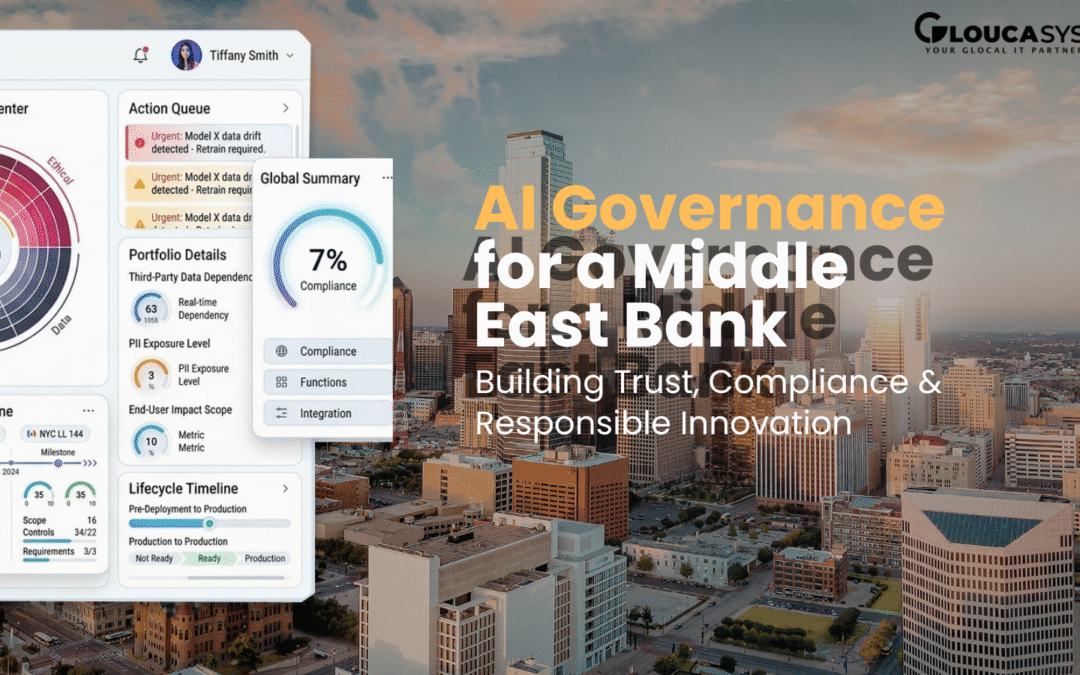
A leading Middle East bank was accelerating its adoption of AI across critical functions such as credit scoring, fraud detection, customer analytics, and decision automation. While these use cases offered strong business value, they also introduced growing concerns around accountability, fairness, transparency, and regulatory compliance.
MyAIGovern- Finance
Business Challenge
As AI adoption expanded, the bank needed a structured governance framework to ensure responsible and compliant AI usage. The key challenges included:
- Lack of clear ownership and accountability for AI systems
- Gaps in governance across the AI lifecycle
- Risk of bias in AI-driven decisions
- Limited explainability and traceability
- Weak integration of AI risks into enterprise risk management
- Increasing regulatory pressure from frameworks such as the EU AI Act and regional UAE AI governance requirements
MyAIGovern- Finance
For a Middle East bank operating in a highly regulated environment, these issues created both compliance risk and reputational exposure.
Solution
Gloucasys addressed these challenges through My AI Govern, a structured AI governance framework built for financial institutions. The solution supports alignment with ISO/IEC 42001, the EU AI Act, and UAE AI governance guidelines, helping banks establish stronger governance, transparency, and operational control.
The solution included:
- ISO/IEC 42001 implementation for an AI management system
- AI risk and compliance assessments
- AI lifecycle governance across design, development, and deployment
- Tailored AI policies and governance frameworks for banking
- EU AI Act readiness assessment, gap analysis, and roadmap
- Algorithmic audits for fairness, accountability, and transparency
- Integration of Dubai AI governance guidelines and banking directives
Engagement Approach
The implementation followed a structured methodology:
- Discovery and Persona Mapping
Stakeholder needs were identified, and governance roles were clearly defined. - AI Governance Gap Assessment
Existing AI governance practices were evaluated to identify maturity gaps and compliance risks. - ISO/IEC 42001 Controls Implementation
Required controls were deployed to establish an auditable AI governance framework. - AI Risk Register and Model Audit Support
AI risks were documented, and audit support was provided to strengthen oversight. - Continuous Compliance Monitoring
Reporting and monitoring mechanisms were introduced to maintain traceability, transparency, and readiness for regulatory review.
Outcomes and Business Value
By adopting a structured AI governance approach, the Middle East bank was better positioned to:
- Strengthen regulatory readiness
- Reduce audit and compliance exposure
- Improve transparency and explainability in AI systems
- Build greater customer trust through fair and auditable AI
- Align innovation with responsible risk management
- Create a scalable foundation for long-term AI adoption
Strategic Impact
For this Middle East bank, AI governance was not only about compliance. It became a strategic enabler for responsible innovation. By embedding fairness, accountability, and transparency into AI operations, the bank could improve governance maturity while reinforcing trust with regulators, customers, and internal stakeholders.
Why It Matters
ISO/IEC 42001 provides a structured and auditable framework for managing AI risks, ethics, and lifecycle controls. It also complements standards such as ISO 27001 and ISO 9001, helping financial institutions integrate AI governance into broader security and quality systems.
MyAIGovern- Finance
Conclusion
As AI becomes more embedded in financial decision-making, governance is becoming essential for every forward-looking bank. For this Middle East bank, adopting a structured AI governance framework helped move AI from a high-potential capability to a more transparent, compliant, and scalable business asset.
Gloucasys supports financial institutions in building responsible, auditable, and trusted AI systems for long-term success.

