
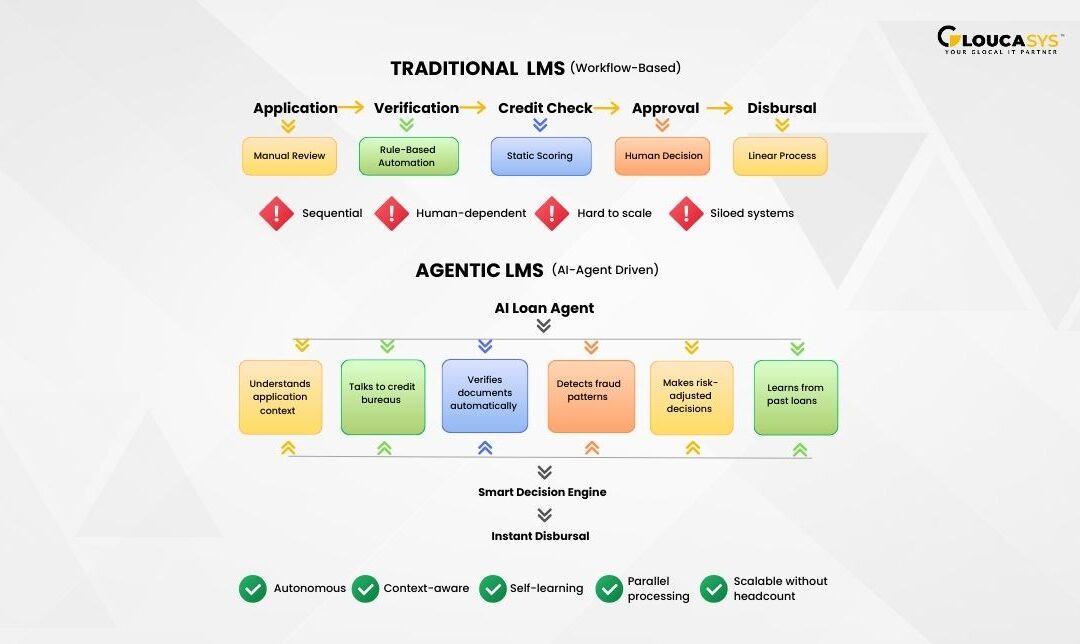
For decades, loan management systems have been built around one core principle:
Move applications from Step A to Step B as efficiently as possible.
Application → Verification → Credit Check → Approval → Disbursal.
This linear workflow model powered the first wave of digital lending. It reduced paperwork. It digitized approvals. It improved visibility.
But today, it’s no longer enough.
We are entering the era of intelligent, agent-driven lending systems — and traditional workflow-based loan management is rapidly becoming obsolete.
The Problem with Workflow-Based Loan Management
Most traditional Loan Management Systems (LMS) operate like structured conveyor belts.
They rely on:
- Predefined rules
- Sequential task routing
- Manual reviews for exceptions
- Static credit models
- Departmental silos
Even when automated, they follow “If → Then → Else” logic.
This creates major limitations:
- Linear Processing
Every application must pass through predefined stages — even if some steps are unnecessary.
- Human Dependency
Edge cases and exceptions require manual intervention, slowing down approvals.
- Limited Adaptability
Risk models are updated periodically, not dynamically.
- Scaling Challenges
To move from 5,000 loans to 50,000 loans, institutions often increase headcount.
In today’s hyper-competitive lending market, this model cannot keep up.
The Rise of Agentic Loan Management Systems
The next evolution in lending is not better workflows.
It is Agentic AI systems.
Instead of moving files between departments, AI agents act as intelligent decision-makers.
An AI Loan Agent can:
- Understand borrower context beyond form inputs
- Analyze structured and unstructured data simultaneously
- Interact with credit bureaus and external APIs in real time
- Detect fraud patterns dynamically
- Apply adaptive risk scoring
- Learn continuously from repayment behavior
- Trigger autonomous actions
This shifts the system from task automation to cognitive automation.
Workflows Execute. Agents Decide.
Here’s the fundamental difference:
Traditional Workflow LMS | Agentic LMS |
Executes predefined steps | Understands context |
Rule-based logic | Reasoning-based decisions |
Manual exception handling | Autonomous resolution |
Sequential processing | Parallel intelligence |
Static scoring models | Self-learning risk models |
A workflow system asks:
“Which step comes next?”
An agent system asks:
“What is the best decision right now?”
That difference changes everything.
Why This Shift Matters Now
The lending ecosystem is becoming:
- Faster
- Data-rich
- API-connected
- Highly competitive
- Risk-sensitive
Customers expect near-instant approvals.
Regulators expect transparency.
Institutions expect cost efficiency.
Traditional LMS platforms were not designed for this level of intelligence or speed.
Agentic systems are.
Business Impact: Beyond Efficiency
This transformation is not just technological. It’s strategic.
Institutions adopting AI-driven agents can:
✔ Approve loans in minutes, not days
✔ Reduce operational cost without increasing teams
✔ Improve fraud detection accuracy
✔ Personalize lending offers dynamically
✔ Continuously optimize risk exposure
✔ Scale exponentially
Technology is no longer backend support.
It is the lending strategy.
The Future of Loan Management
The future LMS will not be a workflow engine.
It will be a network of intelligent agents:
- Credit Evaluation Agent
- Fraud Detection Agent
- Compliance Agent
- Collection Optimization Agent
- Customer Engagement Agent
These agents will collaborate, reason, and act autonomously — while maintaining full auditability and regulatory compliance.
This is the evolution from:
Process Automation → Intelligent Decision Infrastructure.
Final Thought
If your loan management system:
- Cannot integrate seamlessly
- Cannot reason contextually
- Cannot adapt dynamically
- Cannot scale without increasing cost
It will eventually be replaced.
The real question for financial institutions is not:
“How do we optimize our workflow?”
It is:
“How do we redesign lending around intelligence?”
The shift has already begun.
If you’d like, I can also create:
- A Gloucasys-branded version
- A medium-length executive version
- Or a more technical AI-architecture-focused blog aligned with your Conversational & Agentic AI positioning 🚀

